
Multinational automakers extend ties with Chinese firms, affirming confidence in China's market certainty
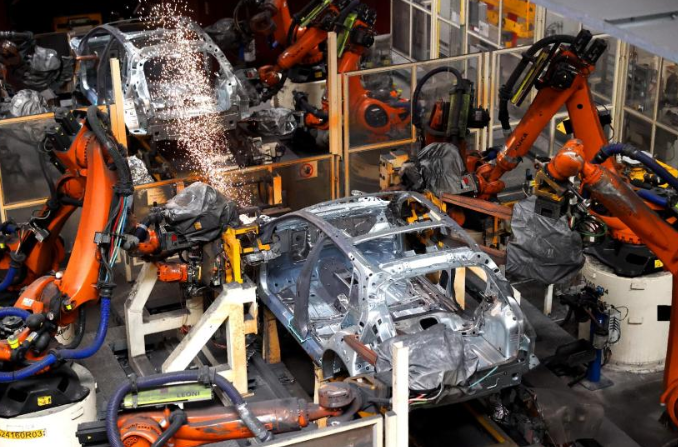
Car bodies are welded by robotic arms in a workshop of a manufacturing facility of joint venture FAW-Volkswagen in Qingdao, east China's Shandong province. (Photo/Liang Xiaopeng)
Recently, several multinational automakers have renewed long-term partnerships with their Chinese partners, signaling sustained confidence in the country's market.
General Motors and Shanghai-based SAIC Motor announced an extension of their joint venture cooperation for another 20 years, through 2047. Earlier, Honda and GAC Group, headquartered in south China's Guangdong province, as well as Volkswagen and SAIC Motor, had also signed agreements to extend their joint ventures.
These decisions by multinational automakers to renew their "long-term" commitments send a clear message: they remain firmly invested in the Chinese market.
More importantly, they point to a broader trend: automotive cooperation between China and other countries is evolving beyond traditional models into a new phase characterized by joint innovation, collaborative research and development (R&D) and shared capability building.
This trend reflects a rational assessment by multinational companies of China's long-term market value.
China is the world's largest automobile market, with annual passenger vehicle sales consistently exceeding 20 million units.
The enormous potential of this market continues to be unleashed. A complete industrial ecosystem, a dynamic environment for technological innovation, and a wealth of real-world application scenarios together give China a combination of advantages that is difficult to replicate elsewhere.
At the same time, China's steady expansion of institutional opening up and continued efforts to improve its business environment provide a stable and predictable foundation for businesses of all kinds to operate and grow in the country.
For many executives of multinational auto companies, China is not only a vast consumer market but also an important platform for enhancing product and technological competitiveness.
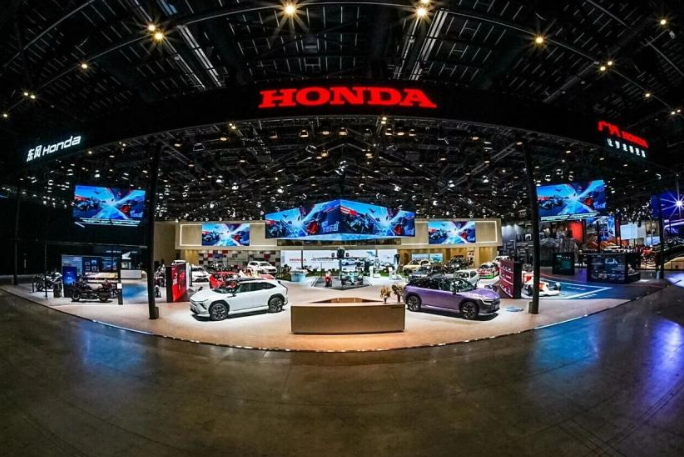
Honda China joins hands with GAC Honda and Dongfeng Honda to showcase a range of exhibits at the Auto China 2026. (Photo courtesy of Honda China)
As German automotive economist Ferdinand Dudenhoffer has put it, leaving China would mean not only giving up the world's largest single automobile market but also severing ties with one of the world's most advanced industrial ecosystems.
The deepening of Chinese-foreign cooperation is also reflected in a profound evolution in the underlying logic of such partnerships. In the early decades of cooperation, technology imports were at the core. Today, multinational giants are increasingly focused on joint innovation, joint R&D, and capability building in China. The country is transforming from a technology importer into a global R&D hub for multinational automakers.
As the global auto industry accelerates its shift toward electrification and intelligent technologies, China's auto industry has stepped up its transformation and upgrading, bringing profound changes to the competitive landscape. These changes are driving Chinese-foreign automotive cooperation toward deeper and higher-level engagement.
The Wall Street Journal has observed that an increasing number of Western automakers are actively exploring new forms of cooperation with Chinese partners.
Ford and China's Geely, for example, have agreed to establish a joint venture in Spain and share production capacity to develop new energy vehicle products for the European market. Mercedes-Benz has introduced "China-specific solutions," with several models featuring voice assistants developed by its Chinese teams.
Besides, an increasing number of multinational automakers are also entrusting their Chinese teams with product definition, technology roadmap decisions, and even leadership of the development of certain global models.
The opportunities offered by China are becoming increasingly diverse, driving a broad-based upgrading of Chinese-foreign automotive cooperation.
Nothing speaks more convincingly than market choices. In recent years, unilateralism and protectionism have gained momentum, while calls for decoupling, severing industrial and supply chains, and relocating manufacturing have resurfaced from time to time. The choices made by multinational automakers serve as a powerful response to this countercurrent.
The automotive industry is one of the most globalized industries in the world. A single vehicle involves tens of thousands of components, requiring extensive coordination and close interdependence across the industrial and supply chains. This is an objective reality shaped by decades of industry development.
Forcibly disrupting industrial and supply chains would only drive up production costs, slow the pace of technological upgrading and ultimately harm the interests of all market participants. Facts have repeatedly shown that openness, cooperation, mutual benefit and win-win outcomes remain the right path in line with the trend of the times.
For multinational automakers, putting down long-term roots in China is, at its core, a choice of broader market opportunities, a more dynamic innovation ecosystem and a more certain future for growth.
By staying true to the original commitment to cooperation, learning from each other and moving forward together, China's auto industry and its global partners can not only create greater value and opportunities for both sides, but also inject a steady source of momentum into the transformation of the global automotive industry and set an example of mutually beneficial international industrial cooperation in the new era.
Editor:董泽坤