
From port to plateau: China-Brazil cooperation extends into Brazil's interior
On June 1, the "Brazil-China New Era Cooperation Forum," co-hosted by the Brazil-China Innovative Economy Research Institute and the municipal government of Juiz de Fora, was held as part of the city's 176th anniversary celebrations. More than 300 representatives from government, business, academia and cultural institutions from both countries gathered to discuss trade, investment, technological innovation, and people-to-people exchanges. One keyword was repeatedly emphasized throughout the forum: logistics.
Participants agreed that as logistics networks continue to extend deeper into Brazil's interior, China-Brazil cooperation is gradually expanding from coastal ports and trade corridors to broader inland regions, driving deeper collaboration in industry, innovation, and cultural exchanges.

The "Brazil-China New Era Cooperation Forum," co-hosted by the Brazil-China Innovative Economy Research Institute and the municipal government of Juiz de Fora is held on June 1. (People's Daily/Chen Yiming)
A strategic hub in southeastern Brazil
Located at the intersection of the three major metropolitan areas of Rio de Janeiro, São Paulo and the state capital Belo Horizonte, Juiz de Fora is an important transportation and industrial hub in southeastern Brazil.
"We hope to strengthen our logistics and manufacturing base through Brazil-China cooperation, enhance the city's position in regional industrial chains, and create more opportunities for youth employment and innovative development," Mayor Margarida Salomão said at the forum's opening ceremony.
Logistics emerged as one of the most discussed topics at the forum.
Jing Yanhui, commercial counselor of the Chinese Consulate General in Rio de Janeiro, noted that China has become the largest trading partner of Minas Gerais. He said cooperation should build on traditional trade while expanding into areas such as technological innovation, urban governance, green development and cultural exchange. He suggested using sister-city ties as a bond, technological cooperation as a lever, and logistics hubs as a foundation to generate replicable and scalable cooperation outcomes.
Brazilian Federal Deputy Ana Pimentel believes that Brazil-China cooperation should further extend into technological innovation and talent development. She said that relying solely on traditional trade can no longer meet development needs, calling for stronger integration of education, research and industry to push cooperation toward higher value-added fields.

Some Chinese and Brazilian participants pose for a group photo during a break at the forum. (Photo by Liu Huiling)
Extending supply chains from ports to the interior
For many participants, logistics is not only the infrastructure linking China-Brazil trade but also a crucial support for extending cooperation into the interior.
Fang Bo, general manager of the Rio de Janeiro branch of COSCO Shipping Lines (Brazil), said a more critical task is to extend its maritime capabilities inland, forming an end-to-end supply chain service system that covers both ports and inland cities. "If an inland Brazilian city like Juiz de Fora can be efficiently connected to the port logistics system, it is expected to create a land-sea multimodal corridor, further reducing overall costs for enterprises and driving industrial clustering," he said.
Fang Ke, general manager of Anjun Logistics, noted that with the rapid growth of cross-border e-commerce, the importance of logistics infrastructure has become increasingly prominent. The company is continuously increasing its investment in Brazil's interior and participating in the development of regional logistics hubs.

Prior to the forum, a China-Brazil cooperation exchange seminar is held. (People's Daily/Chen Yiming)
Innovation and the digital economy
The extension of logistics networks into the interior also creates conditions for innovative resources and the digital economy to enter inland areas.
A representative from the Innovation and Technology Transfer Center of the Federal University of Juiz de Fora expressed strong interest in deepening cooperation with China. "We look forward to establishing closer partnerships with Chinese universities, science parks and innovation platforms, and carrying out joint projects in digital creativity, software development, and technology education, making innovation a new hallmark of Brazil-China cooperation," he said.
Zeng Zhenhao, overseas market director of the China-Latin America and Caribbean Trading Platform, said the Latin American e-commerce market is in a phase of rapid growth with broad prospects for the next five years. The platform will focus on smart security, smart home appliances and other tech products, building a specialized cross-border digital trade system to support small and medium-sized Chinese enterprises in entering the Latin American market.
Fostering local cooperation and people-to-people bonds
As economic and trade cooperation deepens, people-to-people exchanges are also expanding into wider areas.
Chen Xiangguang, general manager of Brazil CBA Cultural Media, believes that Brazil-China cooperation is not only about economic and trade exchanges but also a process of cultural mutual learning. Film and digital content cooperation can serve as an important bridge. Through co-produced documentaries, animation and short video projects, people on both sides can gain a more intuitive understanding of each other's societies and cultures, thus strengthening public support for economic and trade cooperation.
The forum attracted not only local participants from Juiz de Fora but also mayors from Viçosa and Leopoldina in Minas Gerais and Barra do Piraí in Rio de Janeiro state, who led delegations to the event. Participants generally agreed that direct engagement between Brazilian and Chinese local governments should be further strengthened to improve project implementation efficiency and bring the benefits of cooperation to more inland regions.
The day before the forum, some delegates visited Fazenda Ondas da Mantiqueira, about an hour's drive from Juiz de Fora. Nestled among the mountains, the coffee estate, founded in 1850, is still thriving today.
The estate's manager, Kadu Vidigal, said that growing Chinese demand for traceable, high-quality agricultural products is bringing new development opportunities to local industries. "We look forward to strengthening exchanges with the Chinese market in brand cooperation, channel expansion and standards alignment, to bring more quality products to China."
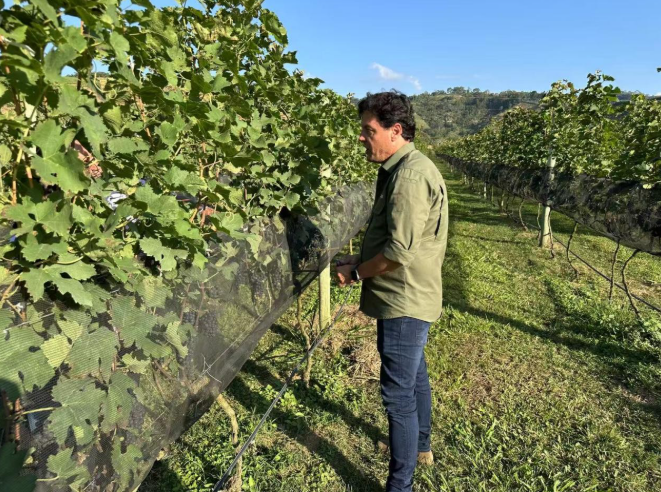
The day before the forum, some delegates visit the coffee estate Fazenda Ondas da Mantiqueira, about an hour's drive from Juiz de Fora. (People's Daily/Chen Yiming)
Prior to the forum, a China-Brazil cooperation exchange seminar was held. The seminar brought together heads of 35 government departments and municipal agencies from Juiz de Fora. They conducted in-depth discussions on cooperation opportunities in areas such as education, health, transportation, agriculture, culture, tourism, technological innovation, and urban development.
Su Ziliang, secretary-general of the Brazil-China Friendship Association, believes that this forum extends bilateral exchanges and cooperation to Brazilian inland cities with significant development potential, serving as a vivid example of aligning the Belt and Road Initiative with Brazil's development strategies.
Cláudia Yanuzzi, president of the Brazil-China Innovative Economy Research Institute, said in her concluding remarks at the opening of the "Brazil-China New Era Cooperation Forum" that Brazil-China economic cooperation is moving from resource complementarity to industrial chain synergy. She believes that the value of the forum lies not only in the event itself but also in opening a window for inland Brazilian cities to understand and engage in cooperation with China.
As China-Brazil cooperation moves from the coast to the interior, more and more Brazilian cities and communities are sharing in the development opportunities generated by the partnership between the two countries.
Editor:董泽坤