
US' last carrier leaves Asia, the bill for overstretch is here
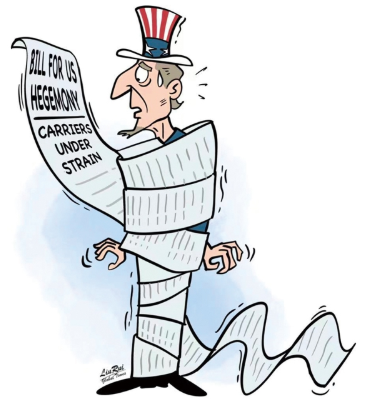
Illustration: Liu Rui/GT
The US is pulling its last aircraft carrier out of Asia.
The USS George Washington has recently passed the Strait of Malacca on its way to the Middle East, where it will replace the USS Abraham Lincoln, a carrier that has already spent over 250 days at sea with 5,000 sailors aboard. The Associated Press put it bluntly: The "war against Iran is stretching the limits of US aircraft carriers and leaving the western Pacific without one of the key American warships." The waters have now become a zero-US-carrier zone.
This is not a routine rotation. A country that claims 11 active aircraft carriers is now being forced to pick a side between two oceans. Overstretching resources has finally put a hard choice on Washington's desk.
For years, Washington has talked about pulling back from the Middle East and shifting focus to the homeland, the Western Hemisphere, and the "Indo-Pacific." Reality is doing the opposite. The conflict with Iran is once again dragging the US' valuable naval assets back to the Middle East.
Since the end of WWII, the carrier strike group has been the clearest symbol of American sea power. It is more than a warship - it is a diplomatic tool, a political posture, and the proud product of its industrial system. The problem today is brutal: Keeping up high-intensity operations in one theater often means giving up presence in another. When commitments exceed the number of carriers the US can actually deploy, the math turns ruthless.
The Lincoln makes the cost concrete. Reports say it broke the modern record for the longest consecutive, uninterrupted period at sea without a port call, supporting operations against Iran. This has led to extreme fatigue, low morale, and mental strain. At least two sailors had to be prevented from jumping overboard, and multiple incidents occurred aboard.
The Navy has acknowledged that traditional supply hubs in the Middle East were disrupted by combat actions, which led to shortages and loss of mail aboard the aircraft carrier.
There was a time when American military power meant more than advanced weapons. It meant ice cream in the desert and cold soda at the front - a logistical abundance built on industrial depth. Today the picture is different: moldy showers, broken plumbing, non-functional laundry, and shortages of basic supplies. Even the simplest parts of life at sea are under strain.
Eleven carriers still feel stretched thin for a reason. They must cycle through deployment, training, maintenance, and overhaul. In normal times, only two or three are actually available for forward operations - the rest are in repair or not ready to sail. That's understandable. What's harder to explain is the case of the USS Gerald R. Ford. Once billed as the warship of the future with built-in Electromagnetic Aircraft Launch System, it is now going back to legacy steam catapults instead given its failure rate was far higher than planned. When new technology keeps on breaking down, all that advanced design just becomes another problem.
The last thing a fleet that is already stretched thin, with morale cracking and technology falling short, should be doing is lighting fires across the globe. The Washington can fill a temporary gap. It cannot repair the deeper hole left by sustained overstretch. And who can guarantee it won't become the next Lincoln?
American allies in the Western Pacific see this vacuum clearly. Washington keeps talking up the "China threat" and pushing Japan and the Philippines to take more forward roles. Yet just as the last US carrier is leaving the region, what Tokyo and Manila are feeling is not only insecurity, it is a reminder that even American security commitments have limits.
The Middle East is delivering a hard lesson. Wars are rarely decided by how many carriers a country owns. They are decided by whether the country can keep feeding replacements, repairs, and organizational resilience into the fight. If operations against Iran already strain people and logistics this badly, the constraints of facing a full industrial peer would be far heavier.
This does not mean the US military has suddenly become a paper tiger. Washington has simply left the era of easy dominance. Its instinct to reach for military solutions remains, but industrial capacity has not kept pace with growing global demands, and rivals have learned to impose costs far more cheaply. The real contest in the future is about industrial output, maintenance cycles, and organizational endurance.
The sudden absence of a carrier in the Western Pacific is not an accident. It is a bill coming due. Overstretching resources does not bring a great power down overnight. It just makes every quick‑fix cost more - and piles problems harder to resolve down the line.
Editor:董泽坤