
Letter from China: A southern coastal city's quiet rebirth
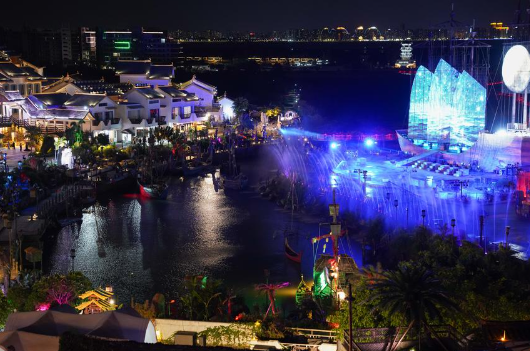
This photo taken on Oct. 20, 2025 shows a night view of a scenic area in Hepu County of Beihai City, south China's Guangxi Zhuang Autonomous Region. (Xinhua/Zhou Jiayi)
The sun had already cleared the horizon over Beihai, a coastal city in south China's Guangxi Zhuang Autonomous Region. On a warm winter morning, I watched a fisherman pry open a clam on the mudflats, just beyond a cordoned-off area of mangrove trees.
Inside the clam was a single South China Sea pearl -- round, lustrous, warm-hued, the kind of pearl that would have bought passage on a ship bound for Persia two millennia ago and was once coveted by lords and ladies from Chang'an to Rome.
"This is what we've been selling since forever," the fisherman said. "Not just the pearl, but the story behind it, and the one still unfolding."
Beihai has always been a city of departures and arrivals. Over 2,000 years ago, its port at Hepu County, which was one of the cradles of the Maritime Silk Road, served as one of the world's first conduits for global trade. Roman glass beads, Persian pottery and Arabian incense flowed into imperial courts of the Western and Eastern Han Dynasties (202 BC- 220 AD), and Chinese silks and ceramics sailed the other way.
Evidence is still turning up in the tombs around Hepu -- more than 5,200 Han-era artifacts are now housed in the county museum.
For decades, Beihai has drawn holiday crowds with an instagrammable seaside escape prized for winter warmth and fresh seafood, yet somehow adrift and half asleep.
"I always felt something essential was missing," said a cab driver from Heilongjiang in the northeast who settled here a decade ago. "We northerners came for the sunshine, the affordable housing, the seafood. That was it, no deeper pull."
That has changed, deliberately and quickly.
Since 2017 the central government has urged Beihai to "promote the 21st Century Maritime Silk Road." The city has responded by pouring money, concrete and creative vision into an ambition that reaches beyond tourism: to become a cultural and maritime hub.
In the first three quarters of this year, Guangxi as a whole welcomed 860 million visitors, up 12.9 percent year on year, and generated 910 billion yuan (128.6 billion U.S. dollars) in revenue, up 13.6 percent year on year.
Beihai, in particular, hosted over 54 million visitors during the same period and earned about 71.1 billion yuan in tourism revenue, a jump of 15.11 percent from a year ago.
The strategy looks simple on paper: fuse the ancient with what shapes the present moment.
An annual cultural week in Beihai, now in its seventh year, has become the showcase of this strategy as a festival of film, art and performance.
The Han-cultural Museum of Hepu County, which is the country's repository devoted to Maritime Silk Road relics of that era, tells a story with quiet gravity.
Curators point to Persian jars and Mediterranean glassware as proof that globalization is not new here; it is woven into the area's DNA, born of the Western Han's yearning for the outside world.
The signature Maritime Silk Road Port scenic area now lets visitors wade through oyster farms at low tide, wander a recreated Han-era harbor where actors in period costume haggle over imaginary cargo, and watch a nightly "Song of Water and Fire" pyrotechnic display.
At Tieshan Port, cargo ships from Southeast Asia and Europe now dock regularly, with new berths being added for a growing fleet.
Visa-free travel policies for tour groups are set to turn the city into a favored gateway for Southeast Asian visitors. International chains like Marriott and InterContinental have also planted flags along the shoreline.
During this year's cultural week, I joined a handful of foreign vloggers who strung necklaces from pearls harvested in the shallows, walked mangrove-lined boardwalks with conservation specialists, dug for clams and sandworms -- local delicacies -- alongside barefoot locals, and stood amazed beneath port-side fireworks.
Their videos, released in Mandarin, English, Tagalog and Indonesian, have racked up millions of views.
On my last evening, I walked Silver Beach -- the famous 24-kilometer ribbon of quartz-white sand.
Against an orange sunset, a wedding photoshoot unfolded next to a group of Vietnamese tourists choreographing a TikTok dance to pulsing K-pop. And on a sand-covered promenade nearby, an old lady sold grilled oysters from a mottled cart that looked far older than most of the resorts behind her.
Two thousand years ago, ships left this shoreline carrying the wealth of an empire. Today, they return laden not with silks, but with people looking for the same thing they always have: connections across waters.
Editor:伏娅敏