
China's innovation ecosystem creates global opportunities
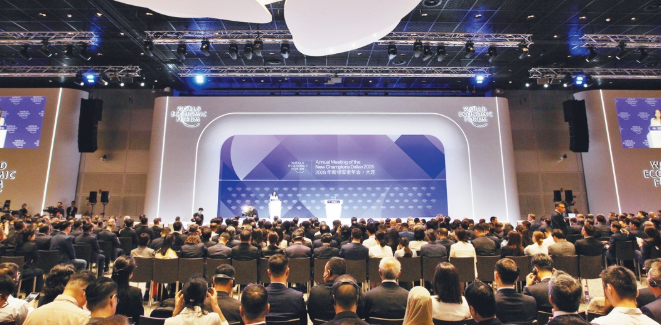
The 2026 Summer Davos forum is held at the Dalian International Conference Center in Dalian, northeast China's Liaoning province, June 24. (Photo/Bai Lin)
The 17th Annual Meeting of the New Champions of the World Economic Forum (WEF), also known as the 2026 Summer Davos forum, wrapped up in Dalian, northeast China's Liaoning province on June 25 after three days of discussions on the future of technology, industry and global innovation cooperation.
Against a backdrop of slowing global growth, geopolitical tensions and mounting uncertainty, the forum sent a positive message of seeking new solutions and advancing together through cooperation.
Inside and outside the conference venue, one consensus has grown increasingly solid: driven by innovation, China is elevating its development opportunities. As it delivers greater market dividends, the country is also sharing a rising stream of innovation dividends with the globe.
Innovation has consistently been central to Summer Davos themes. This year's "Innovating at Scale" discussions emphasized the crucial shift from technological breakthroughs to widespread application, transforming new ideas into tangible productivity that drives economic growth and improves lives.
Discussions on advances in Artificial Intelligence (AI) and robotics generated significant interest. A focal point became the rapid emergence and adoption within China of new technologies, products, and business models.
In recent years, China has demonstrated swift uptake across large AI models, new energy, electric vehicles, advanced manufacturing, humanoid robots, and the burgeoning low-altitude economy. This transition, moving specific innovations into broad industrial applications, has yielded replicable models and valuable experience.
Stephan Mergenthaler, WEF managing director and chief technology officer, highlighted this by noting AI technology's shift towards industrial use. He suggested many developing countries could leverage China's experience to identify their own competitive advantages and effectively integrate into the global AI value chain.
Given the complex international landscape marked by slowing economic growth and turbulence, innovation stands out as a vital path to counter downward pressures and unlock new momentum. Addressing challenges like shifts in global trade patterns, accelerating the energy transition, and maximizing AI investment benefits requires intensified international cooperation.

A sub-forum on Chinese innovation models is held at the Dalian International Conference Center in Dalian, northeast China's Liaoning province, during the 2026 Summer Davos forum. (Photo/Bai Lin)
China's sustained openness serves as a critical enabler in this equation. Increasing numbers of multinationals are expanding their research and development activities such as building R&D centers and regional headquarters in China, not simply to manufacture products but to participate in local innovation and industrial chains.
Their focus increasingly moves from tapping into "Made in China" manufacturing capacity to participating in "Created in China" innovation. Building on this trend, foreign-invested enterprises in China's scientific and technical services sector surged by 27.2 percent year-on-year in 2025, adding 14,000 new businesses.
For global enterprises, this represents "China Opportunity 2.0": deep innovation integration and rewarding investment prospects. For worldwide development, it signifies broader access to advanced technologies and more inclusive sharing of its outcomes.
The forum also devoted considerable attention to China's 15th Five-Year Plan, helping participants gain a clearer understanding of the vast opportunities generated by China's innovation-driven development.
Since the beginning of this year, the Chinese economy has continued to demonstrate new vitality and renewed dynamism. The demand potential of its enormous market has been further unleashed, with service consumption, green consumption and new forms of consumption emerging as particular bright spots.
This demonstration of resilience is contributing needed stability to an uncertain global environment. A prevailing view among attendees was that the 15th Five-Year Plan's strategies for developing "new quality productive forces" and nurturing emerging industries present significant "historic opportunities" for international development partners.
Ultimately, innovation delivers its greatest value when it is shared across the globe. As China's innovations go global and are deployed on a larger scale, more countries, especially developing ones, are gaining access to affordable new technologies and products, injecting fresh momentum into modernization worldwide.
China stands ready to work with all parties to tear down walls and build bridges, stimulate innovation through exchanges and mutual learning, and achieve common growth through mutual success. By enlarging the pie of the global economy through innovation, China seeks to ensure that the dividends of innovation benefit all and provide a continuous source of Chinese strength for the recovery of the world economy.
Editor:董泽坤