
Green computing drives China's digital future as Horinger New Area enters 'millisecond computing circle'
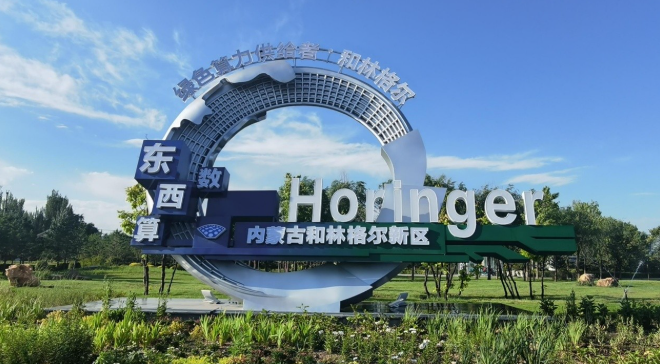
Photo shows the "East Data, West Computing" sculpture in Horinger New Area, Hohhot, north China's Inner Mongolia Autonomous Region. (Photo provided by Horinger New Area)
As a key hub in China's "East Data, West Computing" project, north China's Inner Mongolia Autonomous Region is rapidly transforming into one of the country's leading centers for green computing capacity.
Building on the Inner Mongolia hub of the national integrated computing network, Horinger New Area is strengthening computing infrastructure, boosting the digital economy and integrating green energy with advanced digital technologies. The result is a fast-growing innovation hub supporting emerging industries such as artificial intelligence and big data.
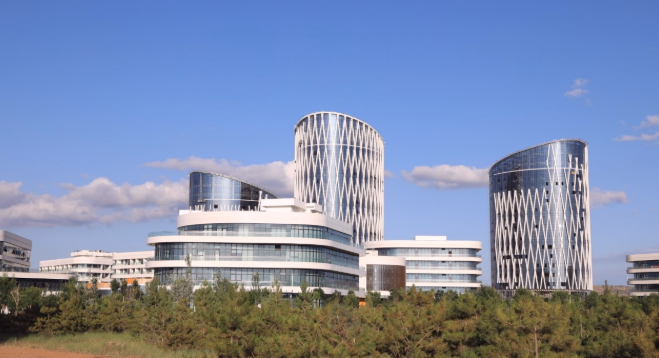
The Talent Innovation Valley in Horinger New Area, Hohhot, north China's Inner Mongolia Autonomous Region. (Photo provided by Horinger New Area)
Drawing on abundant wind and solar resources, the area has prioritized green electricity and built incremental power distribution networks, independent energy storage facilities, and waste-heat recovery and cooling systems, creating a low-carbon ecosystem for data centers.
Green electricity now accounts for more than 80 percent of the power traded by data centers in the area, and more than 86 percent of the electricity used by operational data centers comes from green sources. Electricity costs also remain among the lowest in the country, and the area ranks first nationwide on the green computing power index.
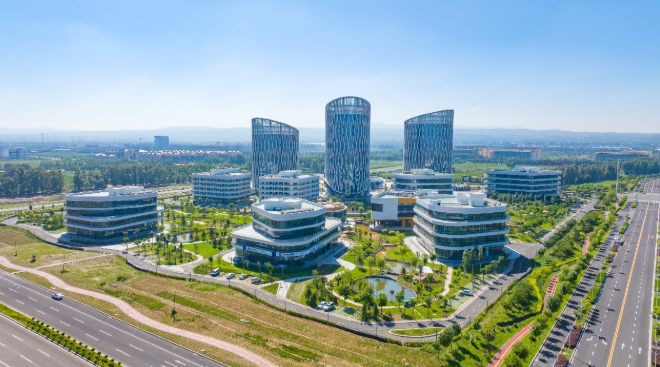
The Talent Innovation Valley in Horinger New Area, Hohhot, north China's Inner Mongolia Autonomous Region. (Photo provided by Horinger New Area)
As its computing network grows more sophisticated, Horinger New Area has fully entered China's "millisecond computing circle." Latency between the local data center cluster and the Beijing-Tianjin-Hebei region is consistently below 5 milliseconds, while latency to the Yangtze River Delta hub is no more than 15 milliseconds.
Latency to the Guangdong-Hong Kong-Macao Greater Bay Area and the Chengdu-Chongqing economic circle remains within 20 milliseconds, enabling seamless connectivity with major computing hubs across the country.
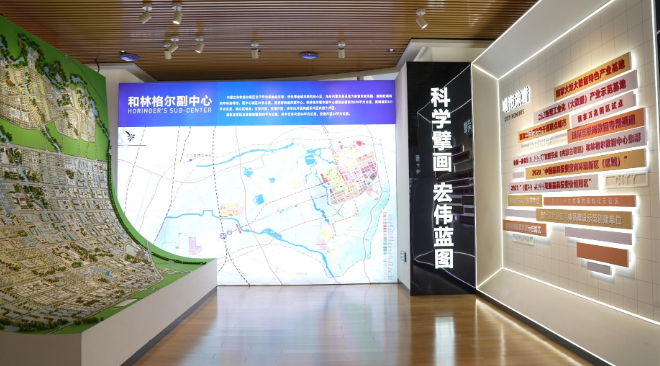
The Digital Exhibition Center in Horinger New Area, Hohhot, north China's Inner Mongolia Autonomous Region. (Photo provided by Horinger New Area)
Located in Hohhot, capital of the autonomous region, Horinger New Area was established in February 2017 and covers a planned area of 496 square kilometers.
Building on its green energy advantages and continuously improving computing infrastructure, Horinger New Area is emerging as a major cluster for the green computing industry. As the national integrated computing network continues to expand, the area is not only becoming a powerful engine for Inner Mongolia's digital economy, but also a showcase of China's efforts to develop digital infrastructure while advancing green and low-carbon development.
Editor:董泽坤