
A closer look at second World Humanoid Robot Games
On the evening of Aug. 26, the second World Humanoid Robot Games came to a close at the National Speed Skating Oval, known as the "Ice Ribbon," in Beijing. Over five days of competition, more than 2,000 robots competed side by side, with numerous records set and broken along the way.
The Games offered a fascinating glimpse into the convergence of technology and sport, while also providing a window into the rapid "evolution" of humanoid robots.
In the highly anticipated 100-meter sprint, Tiangong Ultra, developed by Beijing-based X-Humanoid, took the title in 8.64 seconds, setting a new Games record. It also cleared 3.4 meters in the standing high jump, finished the 400 meters in 38.15 seconds and completed the 1,500 meters in 2 minutes 21.64 seconds. What is enabling this humanoid robot to keep pushing the limits?
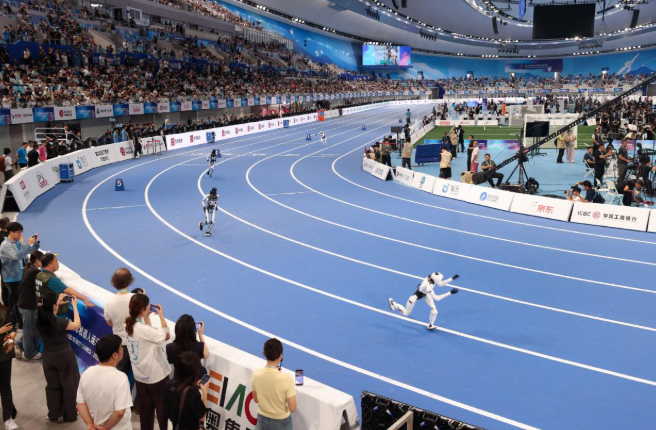
Humanoid robots compete in the 400-meter running small group of the second World Humanoid Robot Games, Aug. 23.
Han Gang, an expert in motion-control algorithms at the Beijing Innovation Center of Humanoid Robotics, said that a robot's athletic performance is, in many ways, determined by the capabilities of its hardware.
"Take the joints, for example. Last year, we were using joint modules with a torque of 300 newton-meters. This year, higher-torque joint modules have become widely adopted across the industry, driving robots to run faster and faster," he said.
More powerful joints, batteries with higher discharge rates, lighter and stronger materials, and more advanced motion-control technologies all contributed to these results. They were not the product of a breakthrough in any single component, but reflected an across-the-board upgrade in algorithms, robot bodies and control technologies, Han said.
The most profound changes at this year's Games, however, were taking place inside the robots' "brains."
Forehand, backhand, moving into position, returning the ball -- during the opening ceremony, a tennis match between former Chinese tennis star Zheng Jie and Xingzai, a humanoid robot developed by Chinese company Galbot, was broadcast online to audiences around the world. As the tennis ball flew toward it at high speed, Xingzai made decisions entirely on its own. Even after an unexpected fall, it quickly got back on its feet and continued playing.
"A robot needs to understand the game and make decisions, while ensuring that its body can execute those decisions precisely during high-speed exchanges," said Zhao Yuli, chief strategy officer of Galbot.
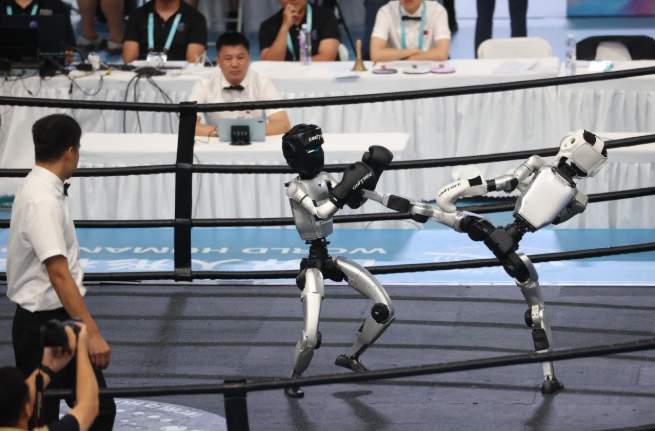
Two robots compete in a kickboxing game of the second World Humanoid Robot Games, Aug. 23. (Photo/Chen Xiaogen)
Galbot has developed its own embodied-intelligence foundation model, AstraBrain, which integrates the robot's "brain," "cerebellum" and neural control systems. Through millions of rounds of training in virtual environments, the system has accumulated the equivalent of decades of human tennis experience.
"The 'brain' is responsible for understanding and decision-making, while the 'cerebellum' translates those decisions into physical movements," Zhao said. "In doubles matches, the robot can also work with human teammates in real time to execute tactics."
Under the rules of this year's Games, all track and field events and other competitive events, with the exception of the 100-meter and 400-meter obstacle races, had to be completed fully autonomously by robots.
"In scenario-based events, fully autonomous operation carries a weighting of 1.0, while teleoperation carries a weighting of only 0.5," said Gong Xiao, deputy director of the China Software Testing Center. "The goal is to make robots truly autonomous and capable of becoming reliable partners for humans."
Robots need not only to run and think, but also to work. This year's Games featured 21 scenario-based events covering a wide range of fields, including industry, hospitality, households and logistics. A dedicated dexterous-hand challenge was also introduced to comprehensively test robots' ability to perform real-world tasks.
In the assembly and feeding event, robots were tasked with replicating actual procedures on an engine cylinder-head assembly line. In the retail service event, they simulated tasks such as restocking shelves and picking items for delivery. In the smart charging service event, robots had to charge three vehicles in succession or disconnect the charging guns and return them to their proper positions within 30 minutes.
The dexterous-hand competition pushed the fine-motor skills of humanoid robots to their limits. Tasks included weighing powder, opening caps and lids, and picking up beans with tweezers. The OmniHand of Chinese robotics company AgiBot won seven of the eight gold medals on offer.
"Dexterous hands are a critical interface through which humanoid robots interact with the physical world. They set the upper limit for robots' ability to perform precision tasks, adapt to different scenarios and operate in real-world environments," said Qiao Tianjie, CEO of AgiLink, a subsidiary of AgiBot.
The OmniHand features 16 degrees of freedom and supports a wide range of commonly used hand gestures and grasping patterns. "We have shipped more than 20,000 units and accumulated over 50,000 hours of real-world data," Qiao said.
In the power tool assembly event, team LinkerBot won the gold medal by completing 18 screw installations in five minutes, operating fully autonomously without any human intervention.
"Manufacturing is undergoing rapid upgrading, creating an urgent need to replace humans in hazardous environments, automate precision processes, and develop more flexible production lines," said Zuo Jiaping, co-founder of LinkerBot, which is based in Beijing.
The hardware behind the team's victory was the company's self-developed high-performance dexterous hand. The complete unit weighs just 370 grams while supporting an ultra-high payload of 50 kilograms.
"We have already achieved breakthroughs in using dexterous hands to assemble robotic arms and using dexterous hands to assemble other dexterous hands. We are continuing to develop an industrial closed loop in which 'robots build robots,'" Zuo said.
The Games may have concluded, but the drive for innovation continues. At the closing ceremony, a comprehensive dataset from the competition was released and made publicly available. The dataset contained massive amounts of real-world operational data collected by multiple institutions during training, preparation and official competitions, totaling more than 2,500 hours.
"We hope this open dataset will provide researchers with the data they need to validate their ideas, and give industry the real-world scenarios it needs to turn experiments into applications," said Jiang Guangzhi, head of the Beijing Municipal Bureau of Economy and Information Technology.
Editor:董泽坤