
At China's Canton Fair, foreign buyers seek more than products
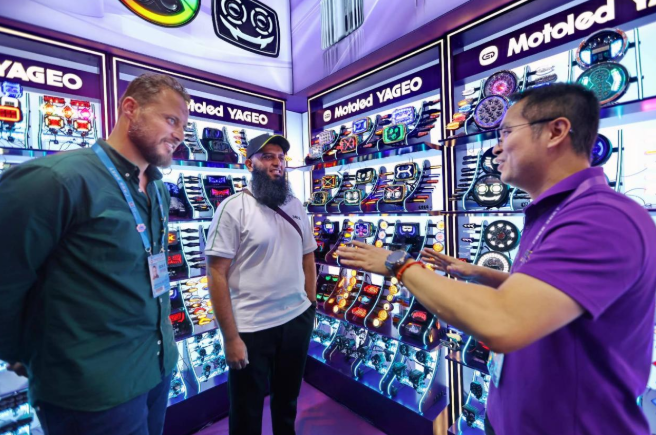
A staff member of a motorcycle part company introduces the company's products to overseas buyers at the motorcycle section of the 140th China Import and Export Fair, Oct. 15. (Photo/Huang Jiming)
The 140th China Import and Export Fair, also known as the Canton Fair, is underway in Guangzhou, south China's Guangdong province, attracting around 340,000 overseas buyers.
Business negotiations remain brisk inside the exhibition halls, but many buyers are also taking their visits beyond the fairgrounds to factories across the Pearl River Delta. They are touring production lines, examining supply chains, and discussing joint R&D.
More and more overseas buyers are coming to China not just to source products, but to find solutions -- a growing trend in China's trade and economic exchanges with the world.
The shift from buying products to seeking solutions reflects a broader evolution in the value China's industries offer.
In the past, international buyers often arrived in China with specific shopping lists. They compared prices, checked delivery schedules, and placed orders, with cooperation largely ending once a transaction was completed.
Today, many overseas buyers come armed with technical blueprints and market hurdles: how to streamline the whole supply chain from product design to mass production; how to drive down costs quickly when rolling out new technologies; and how to shorten R&D lead times amid ever-shifting consumer trends.
These questions are difficult for any single factory to answer on its own. China's comprehensive industrial system and well-developed supply chain networks, however, can provide end-to-end solutions. Overseas buyers who come to China to find partners gain more than a product supplier. They gain access to a complete industrial ecosystem encompassing raw material supplies, component manufacturing, technical services, and large-scale production.
The shift from supplying products to coordinating across entire industrial chains shows how the competitiveness of Chinese manufacturing is increasingly extending across the value chain.
Innovations in new energy vehicles, intelligent manufacturing, and industrial robotics span multiple fields, including mechanical engineering, electronic components, software systems, and materials processing. If any link fails to connect smoothly with the others, a promising technical concept may never make it to mass production.
China's advantage lies in its ability to bring together the necessary supporting resources within a relatively compact industrial network, rapidly adjust designs in response to market feedback, and refine products through large-scale production.
When overseas buyers visit factories in person, they are looking beyond the production capabilities of an individual company. They are also assessing how efficiently upstream and downstream businesses work together and how quickly the wider industrial ecosystem can respond to their needs.
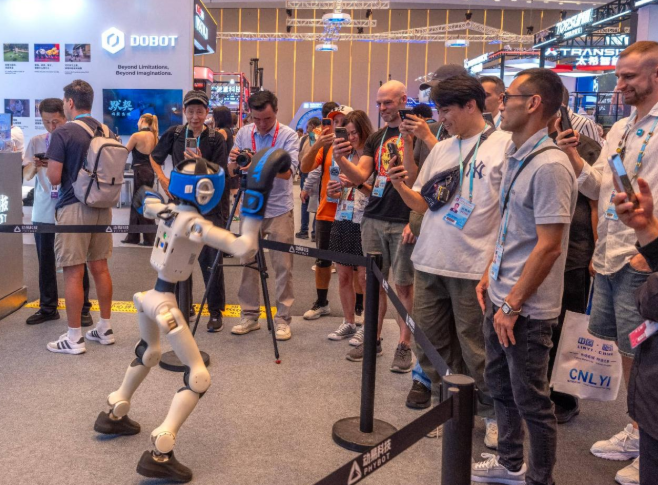
A humanoid robot showcases its boxing skills at the 140th China Import and Export Fair, Oct. 15. (Photo/Wang Meiyan)
The shift from Chinese companies going global to overseas buyers coming to China reflects a change in direction, but the underlying principle remains the same: openness, cooperation, mutual benefit and win-win outcomes.
This is more than a simple reversal of the flow of business. It reflects closer two-way engagement in international trade as industrial specialization deepens. By expanding overseas, Chinese companies can reach new markets and allocate resources globally. Overseas businesses, meanwhile, can tap into China's industrial support networks, technological capabilities and market scale to unlock new growth opportunities.
Supply chains have never been isolated production lines exclusive to a single country. They are collaborative networks in which businesses across countries participate and work together. By complementing one another's strengths, they can create greater value together.
At a time when global industrial and supply chains face multiple sources of uncertainty, businesses are placing greater emphasis than ever on supply chain stability, flexibility and resilience. For overseas buyers, a visit to a Chinese factory is therefore more than a sourcing trip. It is also a vote of confidence in China's industrial capabilities, business environment and development potential.
Where traditional trade exhibitions once functioned primarily as transactional platforms, direct industrial engagement now cultivates enduring partnerships. A single facility tour can initiate a multi-year agreement; a joint production initiative can integrate enterprises across multiple regions.
China's foreign trade is evolving not only in how businesses cooperate, but also in the role Chinese industries play in global commerce. By making better products, strengthening industrial chains and further improving the environment for opening up, China can help more businesses find partners, room for innovation and opportunities for growth. These connections are making the economic and trade ties between China and the rest of the world ever stronger.
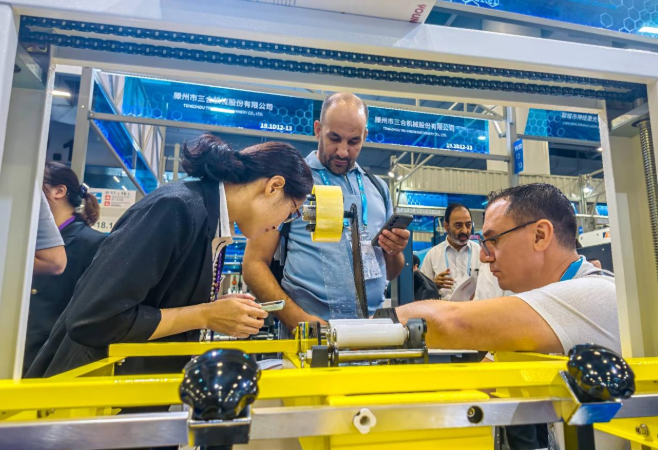
Overseas buyers discuss machinery specifications with a Chinese technician at the machinery and equipment exhibition zone of the 140th China Import and Export Fair, Oct. 19. (Photo/Wang Meiyan)
Editor:董泽坤