
May Day holiday in China's old town brimming with culture, learning, and economic buzz
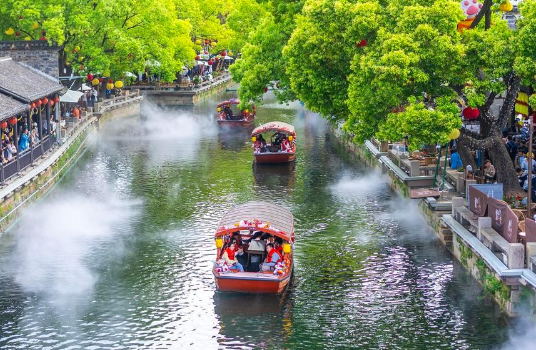
This drone photo shows tourists visiting Huishan ancient town in Wuxi City, east China's Jiangsu Province May 3, 2026. (Photo by Zhou Shegen/Xinhua)
On my rail journey from Chengdu to Yibin, carriages were filled with children and teenagers, their laughter filling the air, free from schoolbooks.
After an hour and a half, I arrived at Yibin Station and went to Lizhuang ancient town. I was struck by the cultural richness and economic vitality of this small town.
On the banks of the Yangtze, China's longest river, Lizhuang has well-preserved the architecture from the Ming and Qing dynasties (1368-1911), including intricate wood carvings, curved tiled roofs, and stone streets.
Lizhuang has a deep wartime legacy, when it became a sanctuary for over 10,000 displaced students and scholars. Local villagers opened their homes, halls and temples, sheltering these refugees and safeguarding China's cultural heritage.
As I wandered through a courtyard repurposed as an education museum, I came upon a family that had driven from Chengdu. The parents said Lizhuang was the first stop on their five-day May Day holiday, a choice to immerse their children in history.
"We hope this trip ignites in them a deep appreciation for history and patriotism," said Liu Dan, the mother. "It's crucial for them to understand that education is a beacon that can alter destiny, even in dark times."
The town's museums showcase its connections with prestigious universities such as Tongji, Tsinghua and Fudan. Nine of the 81 academicians elected by the Chinese Academy of Sciences in 1948 had ties to Lizhuang.
Speaking with Liu's 15-year-old daughter, I saw her eyes bright with understanding. "This visit opened my eyes," she said. "We learned great universities can change a place and its people. Scholars' knowledge even solved the local 'salt poisoning' crisis and improved people's lives."
"It motivates us to study harder," she continued firmly. "By getting into a good university and choosing the right path, we can serve our country meaningfully." She told me her dream is to study law at a top Chinese university.
As I stood, perched looking down on the street, I saw tourists dining in a restaurant in an ancestral hall that served the town's famous thinly sliced white meat with savory sauce. Nearby, children in Hanfu twirled and laughed, their silk sleeves flowing as they enjoyed a professional photo session arranged by their parents.
At Lizhuang ancient town, a scene of history, culture, and vitality unfolds. This is why parents and kids come here for holidays. They can tour, experience, learn and spend.
Traveling to ancient towns is becoming increasingly popular among city dwellers during holidays, with examples such as Wuzhen in east China's Zhejiang Province and Beijing WTown in Beijing. But as Chinese people's demands grow, the market's future depends on meeting needs for deep cultural resonance and emotional satisfaction.
Shao Yong, a professor with Tongji University's College of Architecture and Urban Planning, said urban and rural renewal and rural revitalization require a profound understanding of their living nature and cultural connotations, through which local villages can transition from simply being saved to truly flourishing.
China will promote the in-depth integration of culture and tourism, uphold the principle of "shaping tourism through culture and highlighting culture via tourism," and advance the construction of a strong tourism country, according to the country's 15th Five-Year Plan (2026-2030) for economic and social development.
Editor:伏娅敏