
Education as a Light Brightening the Silk Road's Borderlands — An Interview with Hexi University President Li Guang
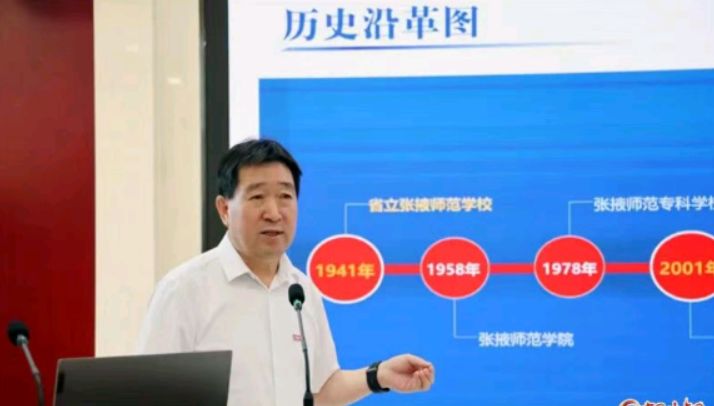
In Zhangye, located in the golden section of the Silk Road and the heart of the Hexi Corridor, sits a distinctive institution of higher learning—Hexi University. It is the only provincial public comprehensive undergraduate university within the nearly 2,000-kilometer stretch from Lanzhou to ürümqi. Over 85 years of educational endeavor, it has consistently aligned with national strategies and resonated with regional development.
Over the past 85 years, the university has steadfastly adhered to its mission of “rooting in Hexi, serving Gansu, and reaching out to surrounding regions.” Committed to national strategies, it has forged a distinctive path of development for a western university in areas such as counterpart assistance, talent cultivation, and educational support to Xinjiang.
On June 9, as part of the online theme activity “Youth Chapter: Tracing Light along the Silk Road,” a press delegation conducted an exclusive interview with Li Guang, President of Hexi University. The event was guided by the Online Communication Bureau of the Cyberspace Administration of China, co-hosted by the Cyberspace Administration of Gansu Province, the Education Department of Gansu Province, and the Gansu Provincial Committee of the Communist Youth League, with special support from the China Internet Development Foundation, and jointly organized by Hexi University, the Cyberspace Administration of Zhangye Municipal Committee, and China Gansu Net. During the interview, President Li shared the university’s journey of progress—rooted in Hexi, leveraging collaborative opportunities, and deeply engaging in aid to Xinjiang—offering a vivid portrayal of the mission and educational commitment of a local higher education institution in western China.
Rooted in Hexi, Building a Rich Foundation
Hexi University traces its origins to the Zhangye Normal School of Gansu Province, established in 1941. It went through successive stages as Zhangye Normal College and Zhangye Teachers College. In 2000, it integrated Zhangye Agricultural School and a vocational secondary school; in 2014, it merged with Zhangye Medical College and Zhangye People's Hospital. Over time, it has gradually formed a structure centered on three core disciplines—teacher education, agriculture, and medicine—while developing five coordinated discipline clusters: teacher education, ecological agriculture, healthcare, applied arts and sciences, and engineering technology.
“The roots of Hexi University run deep in the soil of the Hexi Corridor,” said Li Guang. “Our mission has always been to serve grassroots communities, border regions, and the nation.”
Over 85 years of carrying the torch, the university has cultivated a total of 142,000 graduates across various fields. It has not only supplied a large number of frontline professionals in basic education, agricultural production, and healthcare to the Hexi area, but has also produced top scientists like Li Can, a member of the Chinese Academy of Sciences. Renowned as a world?leading figure in catalysis, Li Can has always remained devoted to Gansu and has contributed to the development of new energy in western China. He stands as a vivid testament to the academic heritage and educational quality of Hexi University.
As a university in western China, Hexi University has always adhered to its mission of “rooting in Hexi, serving Gansu, and reaching out to surrounding regions.” It has integrated its own development into major national strategies such as the Western Development Strategy, the Belt and Road Initiative, and efforts to stabilize border areas and consolidate frontiers. Despite relatively limited resources, it has forged a development path distinguished by clear characteristics and enhanced quality through substantive growth.
Forging Ahead on a New Journey for the Era
In response to the evolving needs of Xinjiang in the new era, Hexi University has proactively upgraded and expanded its engagement.
Its aid to Xinjiang has extended from the original single focus on teacher education to encompass areas such as healthcare, modern agriculture, new energy, and seed industry development. Aligning with Xinjiang's industrial layout, the university has adjusted and optimized its program structure—discontinuing eight traditional programs while strengthening national-level specialty programs like Seed Science and Engineering. It has also established a dedicated employment office in Xinjiang and assigned on-site employment liaison officers, creating a full-chain linkage mechanism from talent cultivation to internship practice to employment and settlement. This ensures that aid efforts to Xinjiang are more targeted, efficient, and sustainable.
Along the long Silk Road, the song of education never ceases; youth pursues dreams, and mission rests on their shoulders.
On this land of hope in the Hexi Corridor, Hexi University is advancing with firm steps and pragmatic actions, cultivating more young talents of the new era who are capable of shouldering the great task of national rejuvenation. It strives to make greater contributions to the development of higher education in western China, the progress of ethnic unity, and the stability of the nation's border areas, while writing an even more brilliant chapter in talent cultivation on the new journey of the new era.
Editor:董泽坤