
Linguistic, aesthetic, cultural -- A French sinologist's decades-long bond with Chinese language
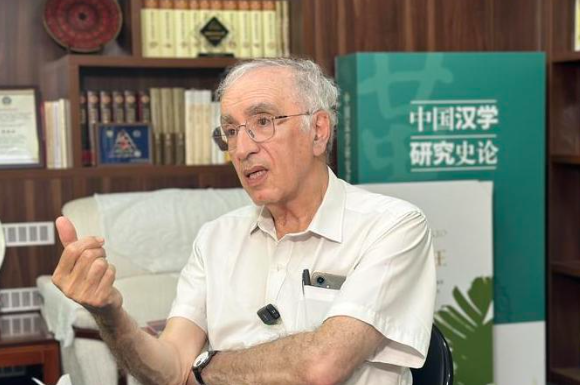
Joel Bellassen speaks during an interview with Xinhua at the World Sinology Center of Beijing Language and Culture University in Beijing, capital of China, June 5, 2025. (Xinhua/Shi Yifei)
It was a full-circle moment for French sinologist Joel Bellassen when he saw the oracle bone inscriptions -- evidence of the written Chinese language from 3,000 years ago -- at the Yinxu Museum in central China's Henan Province this April.
Born in 1950, Bellassen once served as France's first General Inspector of Chinese Language at the Ministry of National Education. The prestigious scholar speaks fluent Mandarin and has been a dedicated promoter of cultural and educational exchange between France and China for decades.
Bellassen's first encounter with the written Chinese language was in his youth, when the Frenchman had been captivated by the characters on Chinese restaurant signage in Paris and the traditional written couplets ornamenting their door frames.
Inspired by this cross-cultural experience, Bellassen enrolled at the University of Paris VIII in 1969, majoring in Chinese. He still recalls that the choice had demanded immense courage, as career prospects related to the Chinese language were quite limited in his country at the time.
Despite the doubts of those around him, Bellassen pursued his passion for the Chinese language at university. There, Bellassen's interest in the exotic language evolved into a genuine love. Whenever he learned a new Chinese character, he would practice writing it over and over again, and he would then share it with his classmates. Later, these peers gave the zealous language learner a nickname: "Chinese."
In 1973, when China and France resumed cultural exchanges, Bellassen seized the opportunity and was in the first group of French students to study in China. "It was very good news for me at that time, and it changed my life," he told Xinhua.
After completing his studies in 1975, Bellassen returned to his home country. He has since dedicated himself to the promotion, study and teaching of the Chinese language, and his life has been closely intertwined with cultural exchange between China and France.
For Bellassen, Chinese characters are not just a linguistic form but a cultural vehicle and poetic creations. He appreciates ancient Chinese poetry and idioms because they use concise language to encapsulate profound thoughts and philosophies.
He can accurately recite the verses of the renowned Tang dynasty (618-907) poet Wang Wei without prompt, or use Chinese idioms such as "Learning-to-Walk-in-Handan" and "Frog-in-the-Well" spontaneously to describe real-life situations or philosophical ideas.
In addition to their epistemic functions, Bellassen said that Chinese characters also have unique aesthetic values. Every stroke of a Chinese character is important, and each must find its proper place. This is a unique form of training that involves both the brain and the hands, he added.
From the 1970s to the present, Bellassen has traveled to China hundreds of times. "Each visit deepens my understanding of Chinese culture. The more I learn, the more I realize how inseparable Chinese characters are from Chinese culture," he said.
This June, he traveled to China to participate in an academic tour organized by his Chinese alma mater, the Beijing Language and Culture University. He was impressed by the changes he saw in the vicinity of the campus -- a quiet field outside his dormitory back in the 1970s has now been replaced by a bustling urban street.
Over recent decades, China has achieved rapid modernization while managing to preserve its various kinds of cultural traditions, Bellassen noted. During his many tours of China, he has also become fascinated by locals practicing calligraphy on the ground in parks or on streets using water rather than ink.
He has recorded the practice with his camera and invested efforts to introduce this ground calligraphy culture to France. In 2019, which was the 55th anniversary of the establishment of China-France diplomatic relations, he joined efforts to launch the first Chinese Character Festival in Paris.
Ground calligraphy also featured in the festival. "I hope this festival becomes an opportunity for people to experience the beauty of Chinese characters firsthand," he said, remarking that his bond with the Chinese language has defined his life.
Editor:伏娅敏